The Sacroiliac Joint
Where is the Sacroiliac Joint?
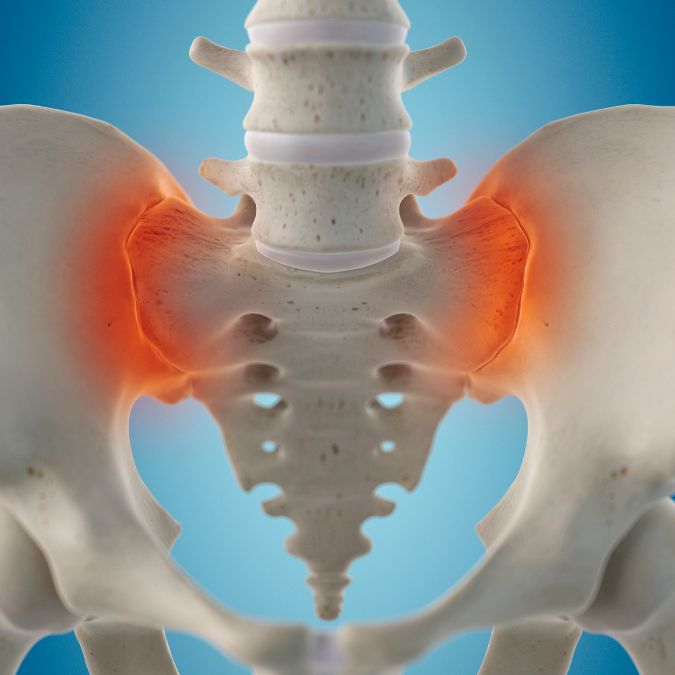
When most people point to their “hip”, they are actually pointing to their sacroiliac joint (SIJ).
The sacroiliac joints are formed between the sacrum (tailbone) and the ilium (pelvis). The hip joint, however, is located at the front near the groin region.
Does the Sacroiliac Joint Move?
Amongst healthcare practitioners, there has been much debate as to whether any movement occurs at this joint. So let’s address that first, as its function and degree of movement is integral in lower back pain treatment.
From Hippocrates (circa 400BC) through to the 17th century, it was thought that the SIJs only moved during pregnancy. Research from the early 18th century began to show that the SIJs do move.
Throughout the 20th century, opinions shifted back and forth. From the 1930s to the 1980s, the SIJs were largely considered immobile and not a source of lower back pain.
Current research supports that:
- The SIJs do move
- Movement ranges from 0–9 degrees
- Most joints move approximately 2–3 degrees
Despite their small range of movement, the SIJs play an important role in locomotion.
They are integral in transferring load between the legs and the spine.
The joint structure is complex, with complementary ridges and grooves that allow:
- Small amounts of movement
- High levels of stability
This is important for joints that handle repeated forces such as walking and running.
Two key concepts help explain this:
Form closure
The structure of the joint itself limits excessive movement and provides stability.
Force closure
Muscles, ligaments, and fascia tighten to support the joint during movement. This is synchronised with forward movement of the sacrum (nutation).
Together, these mechanisms allow the SIJs to:
- Contribute to movement
- Maintain stability
- Distribute forces effectively through the body
What is the Function of the SIJs?
Can the SIJs Be a Source of Pain?
Dysfunction of the SIJ is known as sacroiliac joint dysfunction syndrome (SIJDS) and is a recognised source of lower back pain.
It may account for up to 30% of chronic mechanical lower back pain cases.
When the SIJ becomes dysfunctional or has reduced movement, it can lead to:
- Pain in the buttock region
- Lower back discomfort
- Pain into the back of the thigh
- Symptoms into the hip or groin
When movement is reduced:
- Load through the joint increases
- Inflammation may develop
- Surrounding muscles can become affected
- Postural changes, particularly in the pelvis, may occur
This can lead to increased strain on the lower back.
Chiropractic and the SIJs
It is common for chiropractors to assess movement of the sacroiliac joints.
When reduced movement is identified, care may aim to:
- Improve joint motion
- Reduce inflammation
- Support overall function
Improving movement may help reduce symptoms commonly associated with lower back and leg pain.
What Causes SIJ Dysfunction?
Dysfunction may occur due to:
Macro trauma
- Falls onto the tailbone
- Direct impact injuries
Micro trauma
- Repetitive lifting
- Ongoing strain
- Poor movement patterns
Symptoms may include:
- Pain when walking
- Difficulty getting up from sitting
- A feeling that the leg may give way
What Does the Research Say?
Research into lower back pain can be difficult due to the variety of contributing factors between individuals.
Current findings suggest:
- Exercise programs alone can improve pain and function
- Manual therapy combined with exercise may be more effective for some patients
- Both approaches appear beneficial, with no clear single superior method
Some studies have shown:
- Manual therapy may provide quicker short-term relief
- Exercise may provide stronger long-term improvements
Overall, both approaches can be effective, particularly when tailored to the individual.
Although the sacroiliac joints move only slightly, they play a significant role in:
- Movement
- Stability
- Load transfer through the body
When their function is altered, they can contribute to lower back and pelvic pain.
Understanding how the SIJ works helps guide appropriate care and management strategies.
References
- Al-Subahi M, Alayat M, Alshehri MA, Helal O, Alhasan H, Alalawi A, Takrouni A, Alfaqeh A. The effectiveness of physiotherapy interventions for sacroiliac joint dysfunction: a systematic review. J Phys Ther Sci. 2017 Sep;29(9):1689-1694.
- Dogan N, Sahbaz T, Diracoglu D. Effects of mobilization treatment on sacroiliac joint dysfunction syndrome. Rev Assoc Med Bras (1992). 2021 Jul;67(7):1003-1009.
- Javadov A, Ketenci A, Aksoy C. The Efficiency of Manual Therapy and Sacroiliac and Lumbar Exercises in Patients with Sacroiliac Joint Dysfunction Syndrome. Pain Physician. 2021 May;24.
- Kamali F, Zamanlou M, Ghanbari A, Alipour A, Bervis S. Comparison of manipulation and stabilization exercises in patients with sacroiliac joint dysfunction patients: A randomized clinical trial. J Bodyw Mov Ther. 2019 Jan;23(1):177-182
- Nejati P, Safarcherati A, Karimi F. Effectiveness of Exercise Therapy and Manipulation on Sacroiliac Joint Dysfunction: A Randomized Controlled Trial. Pain Physician. 2019 Jan;22(1):53-61.
- Vleeming A, Schuenke MD, Masi AT, Carreiro JE, Danneels L, Willard FH. The sacroiliac joint: an overview of its anatomy, function and potential clinical implications. J Anat. 2012 Dec;221(6):537-67.